
NextGate PONA Auth — EndPoint Doc (ACTIVE)
For more details on the full flow design: PONA Auth v3 Design Doc
What is PONA Auth?
Progressive · Onboarding · Native · Access
PONA Auth is NextGate's unified, phone-first authentication system. It replaces all legacy auth flows with a single coherent pipeline. Core philosophy:
- Phone is the primary identifier — always. Every account starts with a verified phone number. No exceptions.
- Passwordless by default — users authenticate via OTP. Password and OAuth are optional enhancements added post-registration.
- Progressive onboarding — only the bare minimum is collected upfront (phone + name + birthdate). Everything else (username, email, bio, interests, profile pic) is collected lazily when the feature needs it.
- One flow, two outcomes — the same endpoints serve both new and returning users. The server decides what happens based on account state.
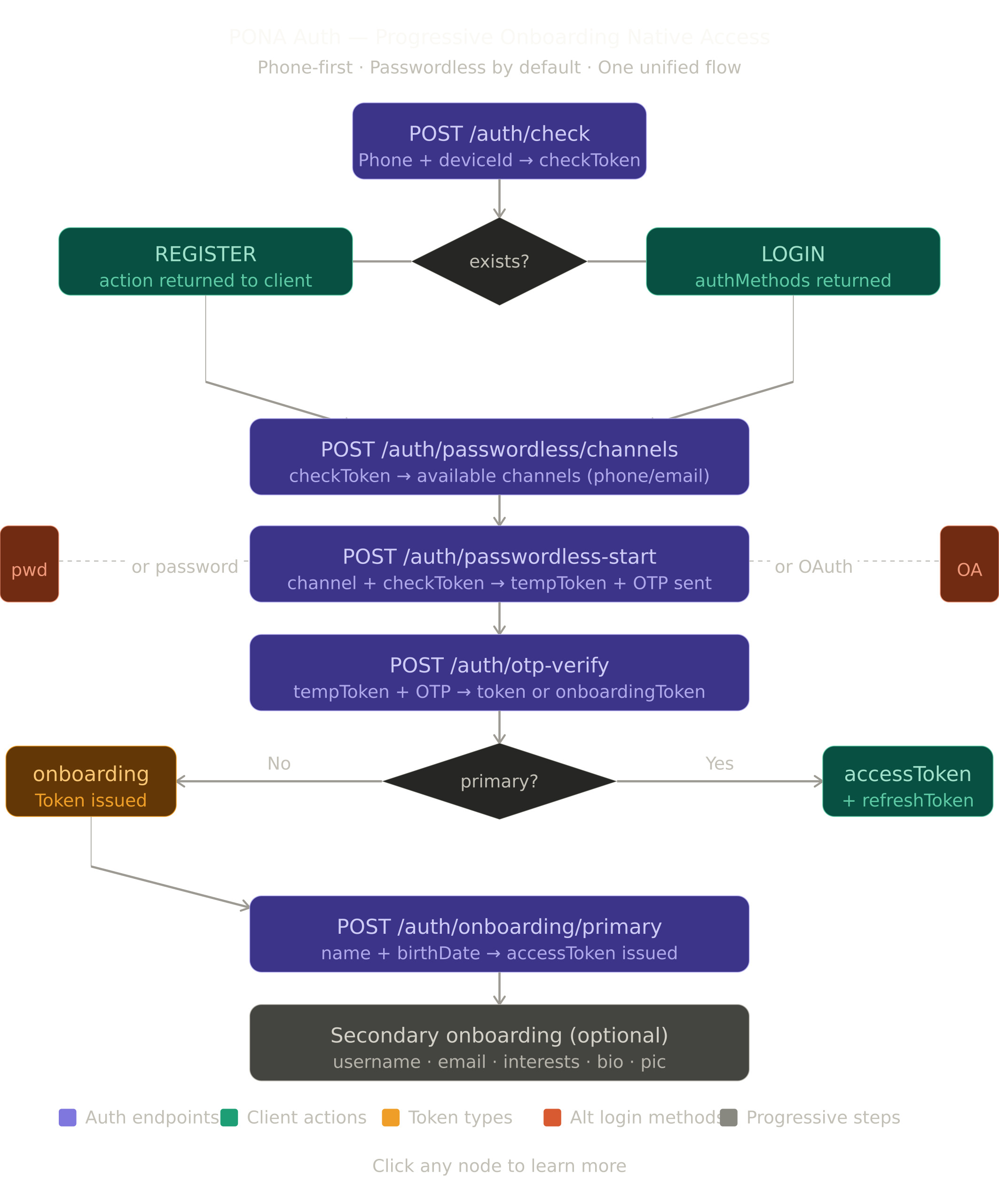
Token types at a glance
| Token | Expiry | Purpose |
|---|---|---|
checkToken |
10 min | Proves a phone check was made. Single-use. |
tempToken |
15 min | Carries the OTP session. Single-use after verify. |
onboardingToken |
1 hour | Issued after OTP verify for new users. Unlocks primary onboarding. |
accessToken |
1 hour | Standard bearer token. Attached to every protected request. |
refreshToken |
30 days | Rotates on use. Used to get a new accessToken silently. |
Secure storage — frontend requirements
Store tokens incorrectly and the whole auth system is compromised.
| Token | Where to store | Why |
|---|---|---|
accessToken |
In-memory only (React state, Zustand, etc.) | Never localStorage — XSS can steal it |
refreshToken |
HttpOnly cookie (web) / Secure Keychain (mobile) | Never localStorage or AsyncStorage directly |
onboardingToken |
In-memory only | Short-lived, no need to persist |
checkToken |
In-memory only | Single-use, discard after consuming |
tempToken |
In-memory only | Single-use, discard after OTP verify |
Standard Response Format
Success response
{
  "success": true,
  "httpStatus": "OK",
  "message": "Human-readable message",
  "action": "ACTION_CODE",
  "action_time": "2026-04-03T10:30:45",
  "data": {}
}
Error response
{
  "success": false,
  "httpStatus": "BAD_REQUEST",
  "message": "Error description",
  "action_time": "2026-04-03T10:30:45",
  "data": "Error description"
}
Action codes
| Code | Meaning | Next step |
|---|---|---|
REGISTER |
Phone not found — new user | Show registration UI, proceed to channels |
LOGIN |
Phone found — existing user | Show login UI, proceed to channels |
CONTINUE_ONBOARDING |
Phone found but primary incomplete | Proceed to channels → onboarding |
PROCEED_TO_OTP |
Only one channel available | Skip channel picker, send OTP automatically |
SELECT_CHANNEL |
Multiple channels available | Show channel picker to user |
COLLECT_PRIMARY |
OTP verified, primary data needed | Show name + birthdate form |
ACCOUNT_BLOCKED |
User is underage or blocked | Show blocked message with unblock date |
VERIFY_DEVICE |
Unknown device on password login | Show device OTP verification |
OTP Channels
OTP can be delivered via the following channels. Not all channels are available in every situation — the server enforces the rules.
Available channel values
| Value | Description | User selectable |
|---|---|---|
SMS |
OTP delivered via SMS | ✅ |
WHATSAPP |
OTP delivered via WhatsApp | ✅ |
SMS_AND_WHATSAPP |
OTP sent to both SMS and WhatsApp simultaneously | ✅ |
EMAIL |
OTP delivered via email | ✅ |
SMS_AND_WHATSAPPfires both sends in parallel on the server. The user gets the OTP on both channels at the same time. If one channel fails, the other still delivers.
EMAIL_AND_WHATSAPP,EMAIL_AND_SMS,ALL_CHANNELSare internal server-side values. Never send these from the client — they will be rejected.
Channel rules by purpose
| Channel | New user (registration) | Existing user (login) |
|---|---|---|
SMS |
✅ | ✅ |
WHATSAPP |
✅ | ✅ |
SMS_AND_WHATSAPP |
✅ | ✅ |
EMAIL |
❌ not allowed | ✅ only if account has a verified email |
Channel request examples
Send via SMS only:
{ "channel": "SMS" }
Send via WhatsApp only:
{ "channel": "WHATSAPP" }
Send via both SMS and WhatsApp at the same time:
{ "channel": "SMS_AND_WHATSAPP" }
Send via email (login only, verified email required):
{ "channel": "EMAIL" }
Shared Objects
UserInfo
Returned by /auth/verify-otp and /auth/onboarding/primary once the user is identified. Frontend devs should persist this in local storage for display use (profile header, greetings, etc.).
{
  "displayName": "Joshua Sakweli",
  "phone": "+255745051250",
  "maskedPhone": "••• ••• ••50",
  "avatarUrl": "https://cdn.example.com/avatars/uuid.jpg"
}
| Field | Type | Description |
|---|---|---|
displayName |
string | null | First + last name. Null until primary onboarding is complete. |
phone |
string | Full unmasked phone in international format. Always present. Safe to store — it is the user's own number, just verified via OTP. |
maskedPhone |
string | Masked phone for visible UI display (e.g. "••• ••• ••50"). Always present. |
avatarUrl |
string | null | URL of the user's profile picture. Null until a profile picture is uploaded. |
Storage guidance:
phone,maskedPhone,displayName, andavatarUrlare display data — localStorage is fine. Do not store tokens in localStorage.
HTTP Method Badges
- GET — Read only
- POST — Create / action
- DELETE — Remove
Endpoints
1. Check Phone
Purpose: Entry point for every auth flow. Checks if a phone number is registered and returns a checkToken plus available auth methods.
Endpoint: POST {base_url}/auth/check
Access Level: 🌐 Public
Authentication: None
Request:
{
  "identifier": "+255745051250",
  "deviceId": "android-uuid-abc123"
}
Request Parameters:
| Parameter | Type | Required | Description | Validation |
|---|---|---|---|---|
identifier |
string | Yes | Phone number in international format | Must match ^\+[1-9]\d{6,14}$ |
deviceId |
string | Yes | Unique device identifier from the client | Non-empty |
Response — New User:
{
  "success": true,
  "httpStatus": "OK",
  "message": "Phone number not registered",
  "action": "REGISTER",
  "action_time": "2026-04-03T10:30:45",
  "data": {
    "exists": false,
    "checkToken": "eyJhbGciOiJIUzI1NiJ9...",
    "primaryComplete": false,
    "maskedPhone": null,
    "authMethods": null
  }
}
Response — Existing User:
{
  "success": true,
  "httpStatus": "OK",
  "message": "Welcome back",
  "action": "LOGIN",
  "action_time": "2026-04-03T10:30:45",
  "data": {
    "exists": true,
    "checkToken": "eyJhbGciOiJIUzI1NiJ9...",
    "primaryComplete": true,
    "maskedPhone": "••• ••• ••50",
    "authMethods": {
      "passwordless": true,
      "password": false,
      "google": true,
      "apple": false
    }
  }
}
Response — Existing User, Primary Incomplete:
{
  "success": true,
  "httpStatus": "OK",
  "message": "Continue setting up your account",
  "action": "CONTINUE_ONBOARDING",
  "action_time": "2026-04-03T10:30:45",
  "data": {
    "exists": true,
    "checkToken": "eyJhbGciOiJIUzI1NiJ9...",
    "primaryComplete": false,
    "maskedPhone": "••• ••• ••50",
    "authMethods": {
      "passwordless": true,
      "password": false,
      "google": false,
      "apple": false
    }
  }
}
Response Fields:
| Field | Description |
|---|---|
exists |
Whether the phone is registered |
checkToken |
Short-lived token to proceed. Always present. |
primaryComplete |
Whether the user has completed name + birthdate setup |
maskedPhone |
Masked phone for display. Null for new users. |
authMethods.passwordless |
Always true |
authMethods.password |
True if user has set a password |
authMethods.google |
True if Google is linked |
authMethods.apple |
True if Apple is linked |
Frontend handling:
action = REGISTER
  → store checkToken in memory
  → do NOT show password field
  → do NOT show Google/Apple buttons
  → proceed to channel picker

action = LOGIN
  → store checkToken in memory
  → show Google button ONLY if authMethods.google = true
  → show Password button ONLY if authMethods.password = true
  → always show OTP button
  → proceed to channel picker

action = CONTINUE_ONBOARDING
  → same as LOGIN
  → user will be redirected to primary onboarding after OTP verify
Errors:
422 UNPROCESSABLE_ENTITY— invalid phone format or missing deviceId
2. Get Passwordless Channels
Purpose: Returns the available OTP delivery channels for the user. Always returns SMS and WHATSAPP. EMAIL is returned only if the user has a verified email.
Endpoint: POST {base_url}/auth/passwordless/channels
Access Level: 🌐 Public
Authentication: None
This endpoint does NOT consume the checkToken.
Request:
{
  "checkToken": "eyJhbGciOiJIUzI1NiJ9...",
  "deviceId": "android-uuid-abc123"
}
Request Parameters:
| Parameter | Type | Required | Description |
|---|---|---|---|
checkToken |
string | Yes | Token from /auth/check |
deviceId |
string | Yes | Must match the deviceId used in /auth/check |
Response — Phone only:
{
  "success": true,
  "httpStatus": "OK",
  "message": "Choose where to receive your code",
  "action": "SELECT_CHANNEL",
  "action_time": "2026-04-16T10:30:45",
  "data": {
    "channels": [
      { "channel": "SMS",      "masked": "••• ••• ••50", "isPrimary": true  },
      { "channel": "WHATSAPP", "masked": "••• ••• ••50", "isPrimary": false }
    ]
  }
}
Response — Phone + verified email:
{
  "success": true,
  "httpStatus": "OK",
  "message": "Choose where to receive your code",
  "action": "SELECT_CHANNEL",
  "action_time": "2026-04-16T10:30:45",
  "data": {
    "channels": [
      { "channel": "SMS",      "masked": "••• ••• ••50",      "isPrimary": true  },
      { "channel": "WHATSAPP", "masked": "••• ••• ••50",      "isPrimary": false },
      { "channel": "EMAIL",    "masked": "j••••••@g••••.com", "isPrimary": false }
    ]
  }
}
This endpoint returns individual primitive channels only (
SMS,SMS_AND_WHATSAPPcompound value is not returned here — the frontend constructs it when the user wants both.
Frontend handling:
Always show at least SMS and WHATSAPP.
If EMAIL is present, show it too.

Suggested UI:
  SMS       → "Text message to ••• ••• ••50"
  WHATSAPP  → "WhatsApp to ••• ••• ••50"
  EMAIL     → "Email to j••••••@g••••.com"

You can also show a "Send to both SMS and WhatsApp" option —
send SMS_AND_WHATSAPP as the channel value in /auth/passwordless-start.

User taps their choice, then call /auth/passwordless-start with that channel value.
Errors:
403 FORBIDDEN— invalid, expired, or already-used checkToken403 FORBIDDEN— deviceId mismatch
3. Start Passwordless OTP
Purpose: Sends an OTP to the chosen channel and returns a tempToken for the verify step. Consumes the checkToken.
Endpoint: POST {base_url}/auth/passwordless-start
Access Level: 🌐 Public
Authentication: None
Request — SMS only:
{
  "checkToken": "eyJhbGciOiJIUzI1NiJ9...",
  "channel": "SMS",
  "deviceId": "android-uuid-abc123"
}
Request — WhatsApp only:
{
  "checkToken": "eyJhbGciOiJIUzI1NiJ9...",
  "channel": "WHATSAPP",
  "deviceId": "android-uuid-abc123"
}
Request — Both SMS and WhatsApp simultaneously:
{
  "checkToken": "eyJhbGciOiJIUzI1NiJ9...",
  "channel": "SMS_AND_WHATSAPP",
  "deviceId": "android-uuid-abc123"
}
Request — Email (login only, verified email required):
{
  "checkToken": "eyJhbGciOiJIUzI1NiJ9...",
  "channel": "EMAIL",
  "deviceId": "android-uuid-abc123"
}
Request Parameters:
| Parameter | Type | Required | Description | Validation |
|---|---|---|---|---|
checkToken |
string | Yes | Token from /auth/check |
Non-empty |
channel |
enum | Yes | Where to send OTP | SMS, WHATSAPP, SMS_AND_WHATSAPP, EMAIL |
deviceId |
string | Yes | Must match deviceId from /auth/check |
Non-empty |
Channel rules:
| Channel | New user (registration) | Existing user (login) |
|---|---|---|
SMS |
✅ | ✅ |
WHATSAPP |
✅ | ✅ |
SMS_AND_WHATSAPP |
✅ | ✅ |
EMAIL |
❌ | ✅ only if verified email exists |
Response:
{
  "success": true,
  "httpStatus": "OK",
  "message": "Verification code sent",
  "action_time": "2026-04-16T10:30:45",
  "data": {
    "tempToken": "eyJhbGciOiJIUzI1NiJ9...",
    "maskedDestination": "••• ••• ••50",
    "channel": "SMS_AND_WHATSAPP",
    "expiresInSeconds": 120,
    "resendAvailableAfterSeconds": 60
  }
}
Response Fields:
| Field | Description |
|---|---|
tempToken |
Carry this to /auth/verify-otp. Store in memory only. |
maskedDestination |
Show to the user so they know where OTP was sent |
channel |
The channel used — display appropriate message |
expiresInSeconds |
OTP valid for this many seconds |
resendAvailableAfterSeconds |
Wait this long before enabling resend |
Frontend handling:
On success:
  → store tempToken in memory
  → show OTP input screen
  → display message based on channel:
      SMS              → "Code sent to ••• ••• ••50 via SMS"
      WHATSAPP         → "Code sent to ••• ••• ••50 via WhatsApp"
      SMS_AND_WHATSAPP → "Code sent to ••• ••• ••50 via SMS and WhatsApp"
      EMAIL            → "Code sent to j••••••@g••••.com"
  → start countdown timer using resendAvailableAfterSeconds
  → enable resend button when timer hits 0

On resend:
  → channel is locked to the original choice
  → resend always goes to the same channel(s)
  → to switch channel, go back to the channel picker and restart the flow
Errors:
403 FORBIDDEN— checkToken invalid, expired, or already consumed400 BAD_REQUEST— EMAIL chosen but account has no verified email400 BAD_REQUEST— EMAIL chosen for registration400 BAD_REQUEST— non-user-selectable channel sent (e.g. ALL_CHANNELS)422 UNPROCESSABLE_ENTITY— invalid channel value
4. Verify OTP
Purpose: Validates the OTP and returns either an accessToken (returning user, primary complete) or an onboardingToken (new or incomplete user).
Endpoint: POST {base_url}/auth/verify-otp
Access Level: 🌐 Public
Authentication: None
Request:
{
  "tempToken": "eyJhbGciOiJIUzI1NiJ9...",
  "otp": "482910",
  "deviceName": "Josh's Pixel 4a",
  "platform": "ANDROID"
}
Request Parameters:
| Parameter | Type | Required | Description | Validation |
|---|---|---|---|---|
tempToken |
string | Yes | Token from /auth/passwordless-start |
Non-empty |
otp |
string | Yes | 6-digit code | Exactly 6 numeric digits |
deviceName |
string | No | Human-readable device name | Optional |
platform |
string | No | Client platform | ANDROID, IOS, WEB |
Response — Primary Complete:
{
  "success": true,
  "httpStatus": "OK",
  "message": "Welcome back",
  "action": null,
  "action_time": "2026-04-03T10:30:45",
  "data": {
    "accessToken": "eyJhbGciOiJIUzI1NiJ9...",
    "refreshToken": "eyJhbGciOiJIUzI1NiJ9...",
    "onboardingToken": null,
    "primaryComplete": true,
    "onboarding": {
      "primaryComplete": true,
      "username": true,
      "email": false,
      "profilePic": false,
      "interests": false,
      "bio": false
    },
    "user": {
      "displayName": "Joshua Sakweli",
      "phone": "+255745051250",
      "maskedPhone": "••• ••• ••50",
      "avatarUrl": null
    }
  }
}
Response — Primary Incomplete:
{
  "success": true,
  "httpStatus": "OK",
  "message": "Phone verified. Let us set up your account.",
  "action": "COLLECT_PRIMARY",
  "action_time": "2026-04-03T10:30:45",
  "data": {
    "accessToken": null,
    "refreshToken": null,
    "onboardingToken": "eyJhbGciOiJIUzI1NiJ9...",
    "primaryComplete": false,
    "onboarding": {
      "primaryComplete": false,
      "username": false,
      "email": false,
      "profilePic": false,
      "interests": false,
      "bio": false
    },
    "user": {
      "displayName": null,
      "phone": "+255745051250",
      "maskedPhone": "••• ••• ••50",
      "avatarUrl": null
    }
  }
}
Frontend handling:
primaryComplete = true:
  → store accessToken in memory
  → store refreshToken in HttpOnly cookie (web) or Keychain (mobile)
  → discard tempToken
  → navigate to home
  → check onboarding flags for secondary prompts

primaryComplete = false:
  → store onboardingToken in memory
  → discard tempToken
  → navigate to primary onboarding screen
Errors:
403 FORBIDDEN— wrong OTP403 FORBIDDEN— OTP expired403 FORBIDDEN— max attempts exceeded (3 wrong OTPs)403 FORBIDDEN— tempToken already used
5. Resend OTP
Purpose: Resends the OTP to the same channel and destination as the original send. Channel cannot be changed on resend. Rate limited to 5 attempts per session with a 60-second cooldown.
Endpoint: POST {base_url}/auth/resend-otp
Access Level: 🌐 Public
Authentication: None
Request:
{
  "tempToken": "eyJhbGciOiJIUzI1NiJ9..."
}
Response:
{
  "success": true,
  "httpStatus": "OK",
  "message": "OTP resent successfully",
  "action_time": "2026-04-03T10:30:45",
  "data": {
    "tempToken": "eyJhbGciOiJIUzI1NiJ9...",
    "maskedIdentifier": "••• ••• ••50",
    "remainingAttempts": 4,
    "expiresIn": 900
  }
}
Frontend handling:
On success:
  → replace tempToken in memory with the new one from response
  → show "Code resent" confirmation
  → reset the countdown timer to resendAvailableAfterSeconds
  → disable resend button again

On 400 — cooldown active:
  → show "Please wait X seconds"
  → do not clear the OTP input

On 400 — max attempts:
  → show "Too many attempts. Please start over."
  → clear tempToken from memory
  → navigate back to channel picker

Channel switching:
  → NOT possible via resend
  → user must go back to channel picker and call /auth/passwordless-start again
Errors:
400 BAD_REQUEST— cooldown period not yet elapsed400 BAD_REQUEST— max resend attempts (5) reached400 BAD_REQUEST— tempToken expired or invalid
6. Primary Onboarding
Purpose: Collects name and date of birth. Completes primary onboarding and issues the first accessToken.
Endpoint: POST {base_url}/auth/onboarding/primary
Access Level: 🌐 Public
Authentication: None (uses onboardingToken in body)
Request:
{
  "onboardingToken": "eyJhbGciOiJIUzI1NiJ9...",
  "firstName": "Joshua",
  "lastName": "Sakweli",
  "birthDate": "1995-06-15"
}
Request Parameters:
| Parameter | Type | Required | Description | Validation |
|---|---|---|---|---|
onboardingToken |
string | Yes | Token from /auth/verify-otp |
Non-empty |
firstName |
string | Yes | User's first name | 1–50 characters |
lastName |
string | Yes | User's last name | 1–50 characters |
birthDate |
string | Yes | Date of birth | YYYY-MM-DD, must be in the past |
Response — Normal User:
{
  "success": true,
  "httpStatus": "OK",
  "message": "Welcome to NextGate!",
  "action_time": "2026-04-03T10:30:45",
  "data": {
    "accessToken": "eyJhbGciOiJIUzI1NiJ9...",
    "refreshToken": "eyJhbGciOiJIUzI1NiJ9...",
    "accountTier": "FULL",
    "onboarding": {
      "primaryComplete": true,
      "username": false,
      "email": false,
      "profilePic": false,
      "interests": false,
      "bio": false
    },
    "blocked": false,
    "unblockDate": null,
    "user": {
      "displayName": "Joshua Sakweli",
      "phone": "+255745051250",
      "maskedPhone": "••• ••• ••50",
      "avatarUrl": null
    }
  }
}
Response — Underage User:
{
  "success": true,
  "httpStatus": "OK",
  "message": "Account blocked",
  "action": "ACCOUNT_BLOCKED",
  "action_time": "2026-04-03T10:30:45",
  "data": {
    "accessToken": null,
    "refreshToken": null,
    "accountTier": null,
    "onboarding": null,
    "blocked": true,
    "unblockDate": "2026-09-15"
  }
}
Response Fields:
| Field | Description |
|---|---|
accessToken |
Bearer token. Store in memory. Null if blocked. |
refreshToken |
Rotation token. Store securely. Null if blocked. |
accountTier |
FULL (18+), RESTRICTED (13–17), MINOR (under 13 — blocked) |
blocked |
True if user is underage |
unblockDate |
Date when user turns 13. Show to user. |
Frontend handling:
blocked = false:
  → store accessToken in memory
  → store refreshToken securely
  → discard onboardingToken
  → navigate to home
  → check onboarding flags for secondary prompts

blocked = true:
  → do NOT store any tokens
  → show age restriction screen with unblockDate
  → do NOT allow navigation into the app

accountTier = RESTRICTED:
  → user is 13–17
  → restrict features per your tier config
Errors:
403 FORBIDDEN— onboardingToken invalid or expired403 FORBIDDEN— primary onboarding already completed422 UNPROCESSABLE_ENTITY— validation errors on name or birthDate
7. Password Login
Purpose: Authenticates a user with phone + password. May require device verification if the device is unknown or risk is high.
Endpoint: POST {base_url}/auth/login/password
Access Level: 🌐 Public
Authentication: None
Request:
{
  "checkToken": "eyJhbGciOiJIUzI1NiJ9...",
  "password": "MySecurePassword123",
  "deviceId": "android-uuid-abc123",
  "deviceName": "Josh's Pixel 4a",
  "platform": "ANDROID"
}
Request Parameters:
| Parameter | Type | Required | Description | Validation |
|---|---|---|---|---|
checkToken |
string | Yes | Token from /auth/check |
Non-empty |
password |
string | Yes | User's password | Non-empty |
deviceId |
string | Yes | Device identifier | Non-empty |
deviceName |
string | No | Human-readable device name | Optional |
platform |
string | No | Client platform | ANDROID, IOS, WEB |
Response — Known Device:
{
  "success": true,
  "httpStatus": "OK",
  "message": "Login successful",
  "action_time": "2026-04-03T10:30:45",
  "data": {
    "accessToken": "eyJhbGciOiJIUzI1NiJ9...",
    "refreshToken": "eyJhbGciOiJIUzI1NiJ9...",
    "onboarding": {
      "primaryComplete": true,
      "username": true,
      "email": false,
      "profilePic": false,
      "interests": true,
      "bio": false
    },
    "requiresDeviceVerification": false,
    "deviceVerificationToken": null,
    "maskedDestination": null
  }
}
Response — Unknown / High Risk Device:
{
  "success": true,
  "httpStatus": "OK",
  "message": "Device verification required",
  "action": "VERIFY_DEVICE",
  "action_time": "2026-04-03T10:30:45",
  "data": {
    "accessToken": null,
    "refreshToken": null,
    "requiresDeviceVerification": true,
    "deviceVerificationToken": "eyJhbGciOiJIUzI1NiJ9...",
    "maskedDestination": "••• ••• ••50"
  }
}
Frontend handling:
requiresDeviceVerification = false:
  → store accessToken in memory
  → store refreshToken securely
  → navigate to home

requiresDeviceVerification = true:
  → store deviceVerificationToken in memory
  → show OTP input with maskedDestination
  → call POST /api/v1/account/device/verify with the OTP
  → on success you get accessToken + refreshToken
Errors:
403 FORBIDDEN— wrong password403 FORBIDDEN— checkToken invalid or expired403 FORBIDDEN— too many failed attempts403 FORBIDDEN— password not set on this account
8. OAuth Login
Purpose: Authenticates a user via Google or Apple. Only available if the provider was previously linked to the account.
Endpoint: POST {base_url}/auth/login/oauth
Access Level: 🌐 Public
Authentication: None
Request:
{
  "checkToken": "eyJhbGciOiJIUzI1NiJ9...",
  "provider": "GOOGLE",
  "idToken": "google-id-token-from-client-sdk",
  "deviceId": "android-uuid-abc123",
  "deviceName": "Josh's Pixel 4a",
  "platform": "ANDROID",
  "state": "optional-state-string"
}
Request Parameters:
| Parameter | Type | Required | Description | Validation |
|---|---|---|---|---|
checkToken |
string | Yes | Token from /auth/check |
Non-empty |
provider |
string | Yes | OAuth provider | GOOGLE, APPLE |
idToken |
string | Yes | ID token from Google/Apple client SDK | Non-empty |
deviceId |
string | Yes | Device identifier | Non-empty |
deviceName |
string | No | Human-readable device name | Optional |
platform |
string | No | Client platform | ANDROID, IOS, WEB |
state |
string | No | Opaque state value passed back in response | Optional |
Response:
{
  "success": true,
  "httpStatus": "OK",
  "message": "Login successful",
  "action_time": "2026-04-03T10:30:45",
  "data": {
    "accessToken": "eyJhbGciOiJIUzI1NiJ9...",
    "refreshToken": "eyJhbGciOiJIUzI1NiJ9...",
    "onboarding": {
      "primaryComplete": true,
      "username": true,
      "email": true,
      "profilePic": false,
      "interests": true,
      "bio": false
    },
    "state": "optional-state-string"
  }
}
Frontend handling:
Before calling this endpoint:
  → check authMethods.google from /auth/check response
  → ONLY show Google button if google = true
  → ONLY show Apple button if apple = true

On success:
  → store accessToken in memory
  → store refreshToken securely
  → navigate to home
Errors:
403 FORBIDDEN— provider not linked (OAUTH_NOT_LINKED)403 FORBIDDEN— idToken invalid or expired403 FORBIDDEN— idToken email does not match linked provider403 FORBIDDEN— checkToken invalid or expired
9. Forgot Password — Initiate
Purpose: Starts the forgot password flow. Sends an OTP to the user's phone via SMS. Does NOT consume the checkToken.
Endpoint: POST {base_url}/auth/password/forgot/initiate
Access Level: 🌐 Public
Authentication: None
Request:
{
  "checkToken": "eyJhbGciOiJIUzI1NiJ9...",
  "deviceId": "android-uuid-abc123"
}
Response:
{
  "success": true,
  "httpStatus": "OK",
  "message": "Password reset code sent to your phone",
  "action_time": "2026-04-03T10:30:45",
  "data": {
    "tempToken": "eyJhbGciOiJIUzI1NiJ9...",
    "resetToken": null,
    "maskedPhone": "••• ••• ••50",
    "accessToken": null,
    "expiresInSeconds": 120
  }
}
Frontend handling:
→ store tempToken in memory
→ show OTP input screen
→ display maskedPhone
→ proceed to /auth/password/forgot/verify-otp
Errors:
403 FORBIDDEN— checkToken invalid or expired403 FORBIDDEN— account has no password set404 NOT_FOUND— account not found
10. Forgot Password — Verify OTP
Purpose: Verifies the OTP and issues a short-lived resetToken.
Endpoint: POST {base_url}/auth/password/forgot/verify-otp
Access Level: 🌐 Public
Authentication: None
Request:
{
  "tempToken": "eyJhbGciOiJIUzI1NiJ9...",
  "otp": "482910"
}
Response:
{
  "success": true,
  "httpStatus": "OK",
  "message": "Identity confirmed. Set your new password.",
  "action_time": "2026-04-03T10:30:45",
  "data": {
    "tempToken": null,
    "resetToken": "eyJhbGciOiJIUzI1NiJ9...",
    "maskedPhone": null,
    "accessToken": null,
    "expiresInSeconds": 0
  }
}
Frontend handling:
→ discard tempToken from memory
→ store resetToken in memory
→ navigate to new password input screen
Errors:
403 FORBIDDEN— wrong OTP403 FORBIDDEN— OTP expired403 FORBIDDEN— max OTP attempts exceeded
11. Forgot Password — Reset
Purpose: Sets the new password. Revokes all existing sessions and issues a fresh accessToken.
Endpoint: POST {base_url}/auth/password/forgot/reset
Access Level: 🌐 Public
Authentication: None
Request:
{
  "resetToken": "eyJhbGciOiJIUzI1NiJ9...",
  "newPassword": "MyNewSecurePassword456",
  "confirmPassword": "MyNewSecurePassword456"
}
Request Parameters:
| Parameter | Type | Required | Description | Validation |
|---|---|---|---|---|
resetToken |
string | Yes | Token from verify OTP step | Non-empty |
newPassword |
string | Yes | New password | Min 8 characters |
confirmPassword |
string | Yes | Must match newPassword | Non-empty |
Response:
{
  "success": true,
  "httpStatus": "OK",
  "message": "Password updated. All other sessions signed out.",
  "action_time": "2026-04-03T10:30:45",
  "data": {
    "accessToken": "eyJhbGciOiJIUzI1NiJ9...",
    "resetToken": null,
    "maskedPhone": null,
    "expiresInSeconds": 0
  }
}
Frontend handling:
→ discard resetToken from memory
→ store accessToken in memory
→ clear any existing refreshToken from storage
→ navigate to home
→ show "Password updated successfully"
Errors:
400 BAD_REQUEST— passwords do not match403 FORBIDDEN— resetToken invalid or expired422 UNPROCESSABLE_ENTITY— password too short
12. Refresh Token
Purpose: Exchanges a refresh token for a new access + refresh token pair. Old refresh token is invalidated immediately (rotation).
Endpoint: POST {base_url}/auth/token/refresh
Access Level: 🌐 Public
Authentication: None
Request:
{
  "refreshToken": "eyJhbGciOiJIUzI1NiJ9..."
}
Response:
{
  "success": true,
  "httpStatus": "OK",
  "message": "Token refreshed",
  "action_time": "2026-04-03T10:30:45",
  "data": {
    "accessToken": "eyJhbGciOiJIUzI1NiJ9...",
    "refreshToken": "eyJhbGciOiJIUzI1NiJ9...",
    "expiresIn": 3600
  }
}
Frontend handling:
Call this when:
  → accessToken is expired (401 on a protected request)
  → proactively before expiry (check exp claim in JWT)

On success:
  → replace accessToken in memory
  → replace refreshToken in secure storage
  → retry the original failed request

On 401:
  → clear all tokens
  → redirect to login
Errors:
13. Revoke Token
Purpose: Logs out the user by revoking their refresh token.
Endpoint: POST {base_url}/auth/token/revoke
Access Level: 🌐 Public
Authentication: None
Request:
{
  "refreshToken": "eyJhbGciOiJIUzI1NiJ9..."
}
Response:
{
  "success": true,
  "httpStatus": "OK",
  "message": "Token revoked successfully",
  "action_time": "2026-04-03T10:30:45",
  "data": null
}
Frontend handling:
On logout:
  → call this endpoint with the stored refreshToken
  → clear accessToken from memory
  → clear refreshToken from secure storage
  → redirect to login

If call fails (network error):
  → still clear tokens locally
  → user is effectively logged out on the client
Quick Reference — Full Auth Flow
1. POST /auth/check
   → phone + deviceId → checkToken + action

2. POST /auth/passwordless/channels   (does not consume checkToken)
   → returns available channels: SMS, WHATSAPP, and optionally EMAIL

3. POST /auth/passwordless-start      (consumes checkToken)
   → channel (SMS | WHATSAPP | SMS_AND_WHATSAPP | EMAIL) → tempToken + OTP sent

4. POST /auth/verify-otp              (consumes tempToken)
   → otp → accessToken (returning user) or onboardingToken (new user)

5. POST /auth/onboarding/primary      (if onboardingToken received)
   → name + birthDate → accessToken issued

─── User is now logged in ───

6. Secondary onboarding (optional, progressive)
   → username, email, interests, bio, profile pic
   → each step returns new accessToken with updated onboarding flags

─── Token management ───

7. POST /auth/token/refresh   → rotate tokens silently
8. POST /auth/token/revoke    → logout
Error Handling Summary
| HTTP Status | When it happens | What to do |
|---|---|---|
400 BAD_REQUEST |
Invalid input, item exists, rate limit | Show error message to user |
401 UNAUTHORIZED |
Token expired or invalid | Refresh token or redirect to login |
403 FORBIDDEN |
Wrong OTP, wrong password, token mismatch | Show specific error, let user retry |
404 NOT_FOUND |
Account not found | Show "Account not found" |
422 UNPROCESSABLE_ENTITY |
Validation failed | Show field-level errors |
500 INTERNAL_SERVER_ERROR |
Server error | Show generic error, retry |
No comments to display
No comments to display